
Who this is for: teachers
Available to: teachers on all subscriptions. Free subscriptions include the Grammar section only.
Before you start: a Placement Test assigned to your student.
Contents
- Remove a test that hasn't been started
- Accessing Placement Test results
- Reviewing the Standard Placement Test results
- Reviewing the Adaptive Placement Test results
- Tips, best practices and notifications
Understanding the test results: The test does not give a score. It assigns a proficiency level for student placement. A result like 19/30 is not a level cutoff. The mix of questions varies from student to student, so two students can share the same score but be placed differently. A + indicates performance at the top end of a level, without enough consistent evidence to move fully into the next level.
Levels are determined using per-level thresholds (e.g. 16 correct answers out of up to 20), applied at the end of the test. A student is placed at the highest level where they consistently meet the threshold. If they do not meet the threshold at a higher level, they are placed at the level below.
The order of questions shown in the final report does not reflect the order in which the questions were presented during the test.
When viewing an assigned placement test, there are three different statuses:
- Not started yet (Assigned, not started): You have assigned the test, but the student has not opened it yet. You can still remove the test at this point. See Remove a test that hasn't been started.
- Ongoing (Started, not submitted): The student has opened the test but has not answered all of the questions yet.
- Not reviewed: The test is completed and is ready for you to review. You can only review the results of a completed test.
Remove a test that hasn't been started
- Go to the Teacher Panel and select the Placement Tests tab.
- Select the checkbox next to the test.
- Select Remove, then select OK.
Result: the test leaves the list and a message confirms it was removed.
Note: you can only remove a test before the student opens it. Once it shows Ongoing, it stays assigned.
Accessing Placement Test results
- Teacher Panel: Best overall option. Lists all placement tests ready for review in a single view
- Class Management: Best for reviewing placement test results from a specific class
- Student Profile: Best for reviewing placement test results from an individual student
Teacher Panel: Best overall option. Lists all placement tests ready for review in a single view
- Go to the Teacher Panel.
- Select the Placement Tests tab.
- In the Status column, select Not reviewed to open the test results.
Class Management: Best for reviewing placement test results from a specific class
- Go to the Student Management Panel.
- If you also have the manager role, open the Management menu and select Students.
- Find the class you want to view and select Enter Class Management.
- Find the column for the Placement Test you want to review. You may need to scroll sideways.
- Select Not reviewed to open the test.
Student Profile: Best for reviewing placement test results from an individual student
- Go to the Student Management Panel.
- If you also have the manager role, open the Management menu and select Students.
- Select the student's name.
- In the top row, find the Placement Test.
- Select Show Results to open the test results.
Note: a test marked Ongoing hasn't been submitted yet, so you can't open its results.
Reviewing the Standard placement test results
The Placement Test results page gives a clear overview of your student’s English proficiency and areas for improvement.
Grammar proficiency and overview
- Grammar proficiency level - indicates Can-Do statements for that level
- Listening proficiency - indicates whether it supports the grammar level
- Reading proficiency - indicates whether it supports the grammar level
- Writing proficiency - to be scored by the teacher
- Speaking proficiency - to be scored by the teacher
Review your student's answers on the central chart
- Correct (green): the student answered correctly.
- Did not provide answer (orange): the student selected I don't know.
- Incorrect (red): the student answered incorrectly.
- No answer (grey): questions skipped automatically when a level proved too difficult.
Gap Analysis: Located below the chart. View the most valuable section for lesson planning.
- The level of each error
- The question, student's answer, and the correct answer
- The recommended Off2Class lesson that addresses the gap
The Gap Analysis lists incorrect answers only. Questions answered with I don't know show in the chart as Did not provide answer, without the question text. The Adaptive Placement Test has no I don't know option.
Review the Listening, Reading, Writing, and Speaking sections to gain insight into your student’s broader language ability.
- Listening: Play the prompt your student heard and review their responses. The summary will note whether their listening ability aligns with their grammar level.
- Reading: View the text your student received and see which questions they answered correctly or incorrectly. The summary will note whether their reading ability aligns with their grammar level.
- Writing: Read the student’s written response and evaluate whether it aligns with their other skills.
- Speaking: Listen to your student’s recorded response to evaluate whether it aligns with their other skills.
Note: every Listening and Reading question is pitched at the level the Grammar section found. A student who is secure at that level should score close to 100%. A lower score means the result doesn't support the grammar level. It doesn't mean the student is above it.
Reviewing the Adaptive placement test results
The Adaptive Placement Test provides a streamlined overview of your student’s grammar, reading, listening, writing and speaking proficiency.
Start by reviewing the Grammar proficiency level shown at the top of the page. This indicates your student’s current level based on their responses. The results pair each incorrect answer with a recommended Off2Class lesson. The Adaptive Placement Test doesn’t turn these into a Learning Plan, so you add the lessons yourself. Watch the 4-minute video on building a Learning Plan from Adaptive Placement Test results.
Adjusting a proficiency level
If your professional judgment differs from the test result, you can change the level the Adaptive Placement Test assigned. Each domain is adjusted separately, so you can change the Grammar level without affecting Speaking.
- Open the test results.
- In the left-hand column under Student proficiency levels, find the domain you want to change.
- Select the pen icon next to the level.
- Select the new level from the drop-down, then select Save.
Use the central chart to review your student’s performance across the test and see which questions they answered correctly or incorrectly.
Review the Grammar, Listening, Reading, Writing, and Speaking sections to see:
- The student's proficiency level in each skill area.
- Which questions they answered correctly or incorrectly.
- The recommended Off2Class lesson that helps address gaps.
When reviewing the Writing and Speaking sections, you'll also see explanatory hints next to each question that clarify how it shaped the final score:
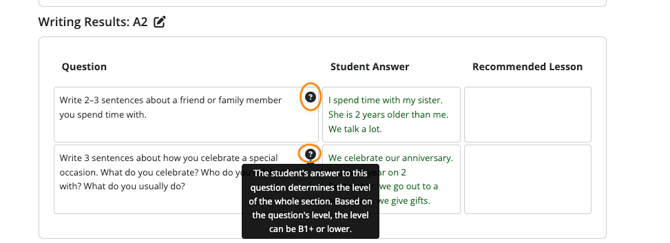
The meaning of the note depends on how difficult that final question was.
If the final question was Easy:
"This answer determines the level of the whole section. Based on this question's level, the result can be B1+ or lower."
This means:
The student's earlier answers led the test to conclude that an Easy final question was the best fit.
Because the test finished on an Easy question, the highest possible outcome for that section is B1+.
The student's answer to that final question determines whether they finish at B1+, B1, A2, or A1, but they cannot receive B2 or higher, because they never demonstrated enough evidence to progress to more difficult questions.
In other words, the final Easy question acts as the upper boundary for the student's possible result.
If the final question was Medium or Hard
"This answer determines the level of the whole section."
This means:
The student progressed far enough for the test to present a Medium or Hard final question. Their answer to that question determines their final proficiency level. There is no upper limit imposed by the question itself. A strong answer on a Hard question may result in a higher proficiency level than a student whose final question was Easy.
Why this is helpful
Teachers sometimes noticed that two students answered the same number of questions but received different levels. These hints clarify that the difficulty of the final question matters, not just whether it was answered correctly. The adaptive test uses the student's entire performance to decide which final question to ask, and that final response confirms the section's overall level.
Writing & Speaking Rubrics
The Writing section of the Adaptive Placement Test is scored using AI technology designed to evaluate written communication in a consistent and objective way. The rubric below is intended to demonstrate the key features and performance areas that contribute to scoring, including organization, mechanics, and lexical range.
| Proficiency Level | Organization | Mechanics | Lexical Range |
|---|---|---|---|
| Absolute Beginner | Student communicates isolated words, copied phrases, or very short responses related to familiar topics. Writing may not yet form complete sentences, and ideas may appear disconnected or heavily dependent on models or prompts. | Student demonstrates emerging control of basic English writing conventions. Writing contains frequent grammatical, spelling, and punctuation errors that may make meaning difficult to understand, although familiar words or patterns are sometimes recognizable. | Student uses a very limited range of everyday vocabulary related to personal information, classroom topics, or immediate needs. Word choice is often repetitive and may rely on memorized language or first-language influence. |
| Beginner | Student writes short simple sentences about familiar topics and can communicate basic ideas in a predictable order. Responses may feel repetitive or minimally developed, with limited use of connectors or supporting details. | Student uses simple sentence structures and familiar grammatical patterns with emerging control. Frequent errors with word order, verb forms, articles, spelling, and punctuation are common, but meaning is generally understandable. | Student uses basic everyday vocabulary to express simple ideas and personal experiences. Vocabulary is limited and repetitive, though the student can communicate familiar information using common words and expressions. |
| Upper Beginner | Student writes connected simple sentences that begin to include reasons, descriptions, or supporting details. Ideas are generally organized in a logical order, though transitions may be limited or repetitive. | Student demonstrates developing control of simple grammar structures and attempts longer or more varied sentences. Errors with verb tense, prepositions, agreement, spelling, and punctuation are still noticeable but usually do not prevent understanding. | Student uses an expanding range of familiar vocabulary to describe experiences, preferences, and opinions. Word choice shows some variety, although vocabulary remains somewhat general and errors in word form or usage may occur. |
| Pre-Intermediate | Student organizes ideas into a clear paragraph or extended response with an identifiable beginning, middle, and ending. Writing includes supporting details and simple transitions to connect ideas, although development may sometimes be uneven. | Student uses a variety of simple and some more complex sentence structures with growing consistency. Grammatical errors are still evident, particularly in more complex forms, but the overall message remains clear and coherent. Spelling and punctuation are generally appropriate for familiar vocabulary and structures. | Student uses a functional range of vocabulary to explain ideas, give reasons, and describe situations in some detail. Vocabulary is generally appropriate to the topic, though word choice may still be somewhat imprecise or repetitive at times. |
| Intermediate | Student develops ideas with relevant details and organizes writing in a logical and cohesive way. Transitions and supporting information help connect sentences and paragraphs, although some parts may still lack depth or precision. | Student demonstrates increased control of grammatical structures, including compound and some complex sentences. Errors may still appear with agreement, tense consistency, or more advanced structures, but they rarely interfere with meaning. Spelling and punctuation are usually accurate. | Student uses a broader range of vocabulary to elaborate, explain, and compare ideas. Word choice is more precise and flexible, though occasional awkward phrasing or misuse of less familiar vocabulary may still occur. |
| Upper Intermediate | Student writes well-organized and sustained responses with clear progression of ideas and effective use of transitions. Writing demonstrates the ability to narrate, explain, contrast, and/or support opinions with multiple relevant details and examples. | Student uses a variety of sentence structures with generally strong grammatical control. Occasional errors may appear in more sophisticated language, but they do not distract from communication. Spelling and punctuation are consistently appropriate and support readability. | Student uses a varied and effective range of vocabulary to narrate experiences, express opinions, explain relationships between ideas, and discuss less familiar topics. Vocabulary is generally accurate and appropriate, though some language may remain somewhat broad or lack nuance. |
| Advanced | Student produces cohesive, well-developed writing that communicates complex ideas clearly and effectively. Organization is purposeful and fluid, with effective transitions, nuanced support, and clear relationships between ideas throughout the response. | Student demonstrates strong control of a wide variety of grammatical structures and sentence patterns. Minor errors may still occur in complex language use, but writing remains polished, clear, and easy to follow. Spelling and punctuation are consistently accurate and enhance clarity. | Student uses a wide and flexible range of vocabulary with increasing precision and sophistication. Word choice supports nuanced meaning, detailed explanation, and stylistic variation, with only occasional minor inaccuracies in less common language. |
The Speaking section of the Adaptive Placement Test is scored using AI technology designed to evaluate spoken communication in a consistent and objective way. The rubric below is intended to demonstrate the key features and performance areas that contribute to scoring, including clarity, grammatical and lexical range, and fluency.
| Proficiency Level | Clarity | Grammatical and Lexical Range | Fluency |
|---|---|---|---|
| Absolute Beginner | Student communicates using isolated words, memorized expressions, or very short responses related to familiar topics. Meaning may be difficult to understand without repetition, gestures, or support from the listener. | Student demonstrates emerging use of basic vocabulary and simple language patterns, often without sentence structure. Errors are frequent and may significantly limit communication, though familiar words or phrases may still convey basic meaning. | Student speaks in very short chunks with frequent pauses, repetition, or hesitation. Speech may rely heavily on prompting or modeling and is often limited to single words or memorized phrases. |
| Beginner | Student communicates simple ideas about familiar topics using short sentences or predictable expressions. Meaning is generally understandable, although ideas may be loosely connected and lack detail or expansion. | Student begins producing subject-verb constructions with some reliability, using simple vocabulary and familiar grammatical structures to express basic information. Frequent errors with verb forms, sentence structure, and word choice are common, but the listener can usually understand the intended message. | Student speaks in short, simple sentences with noticeable pauses and repetition. Speech may sound slow or effortful at times, especially when the student searches for vocabulary or attempts longer responses. |
| Upper Beginner | Student communicates ideas more clearly by adding simple descriptions, reasons, or details. Responses are generally organized and understandable, although connections between ideas may still be basic or uneven. | Student begins using simple verb tenses consistently and forming basic questions. Student uses an expanding range of everyday vocabulary and attempts longer or more varied sentence structures. Errors with grammar and word usage are still noticeable, but they usually do not prevent communication. | Student can sustain a short response with some continuity and less reliance on pauses or repetition. Hesitation may still occur during longer responses or when expressing less familiar ideas, but communication generally continues successfully. |
| Pre-Intermediate | Student communicates complete ideas with relevant details and supporting information. Responses are generally clear and organized, though explanations may remain fairly direct or predictable. | Student uses a variety of simple and some more complex grammatical structures to explain, describe, and give reasons. Student may begin connecting clauses with basic conjunctions (because, but, so). Vocabulary is adequate for familiar and some less familiar topics, although language may still be repetitive or somewhat imprecise. Errors are evident but usually do not interfere with understanding. | Student speaks with growing confidence and can maintain connected speech for an extended response. Pauses and self-corrections still occur, particularly when organizing ideas or attempting more complex language, but overall communication remains smooth. |
| Intermediate | Student communicates ideas clearly and develops responses with explanation, comparison, or reasoning. Ideas are connected logically, and the student can adapt language to support different purposes or situations. | Student demonstrates increased control of grammatical structures and uses a broader range of vocabulary to elaborate and clarify meaning. Student may use subordinate clauses and a range of tenses with general accuracy. Language is generally accurate and flexible, though occasional awkward phrasing or grammatical inconsistencies may still appear. | Student speaks at a generally natural pace and can sustain longer responses with limited interruption. Hesitation is usually connected to planning more detailed or complex ideas rather than difficulty producing language. |
| Upper Intermediate | Student communicates clearly and effectively across a range of familiar and abstract topics. Responses are well organized and include explanation, contrast, and support for opinions, although some ideas may still lack nuance or precision. | Student uses a wide range of grammatical structures and vocabulary to express detailed ideas, speculate, and justify opinions. Student begins controlling complex structures (conditionals, reported speech, passive) with some consistency. Errors may still occur in more sophisticated language use, but they rarely interfere with clarity or overall effectiveness. | Student speaks smoothly and can sustain extended responses with relatively consistent pacing and organization. Occasional hesitation or reformulation may occur when discussing complex ideas, but it does not significantly disrupt communication. |
| Advanced | Student communicates complex and nuanced ideas clearly, effectively, and with strong organization. Responses demonstrate flexibility in explaining, analyzing, and supporting ideas for different purposes or audiences. | Student demonstrates strong control of a broad and flexible range of grammatical structures and vocabulary. Language use is precise and sophisticated, allowing the student to express subtle distinctions and complex reasoning, even though minor errors may occasionally occur. | Student speaks fluently and confidently with natural pacing and strong continuity of ideas. Speech flows smoothly even during complex explanations or abstract discussion, with only occasional hesitation for refinement or emphasis. |
Tips, best practices and notifications
Sharing results with your students
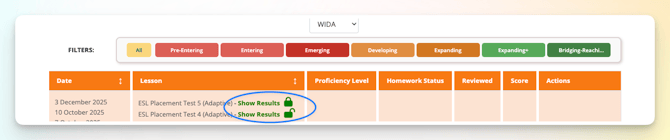
- Go to the Student Management Panel.
- If you also have the manager role, open the Management menu and select Students.
- Select the student's name.
- In the first row, find the Placement Test.
- Use the padlock icon to control access:
- to keep the test results hidden from the student, leave locked
- to share the results, select the padlock to unlock
- to hide the results again, select the padlock to lock it
Review the results together first, as they can be complex for students to interpret on their own.
Once unlocked, your student can view their results by selecting Placement Test under their Completed Work tab.
Additional actions
- From the left-hand column of the test results page:
- Select the printer icon to save the results, or print them as a PDF.
- Create a certificate showing the student's grammar level (available with all paid subscriptions). To download or print it, open the certificate, select the printer icon, then choose Save as PDF or your printer.
- Use the test results to
- group students of the same level together into classes.
- create a customized learning plan for your student. The Standard Placement Test generates one automatically. For the Adaptive Placement Test, you build a custom plan from the lessons recommended in the results.
- Understanding proficiency standards
- Change your default proficiency standard, to update student results and certificates. (CEFR, WIDA, TELPAS, CA ELD, or NY)
- There's no single list of results for a whole class or school in the Teacher Panel. Managers on multi-teacher subscriptions can download every student's Placement Test results as a spreadsheet, then filter it by school, grade or teacher. See how managers export account data.
Notifications
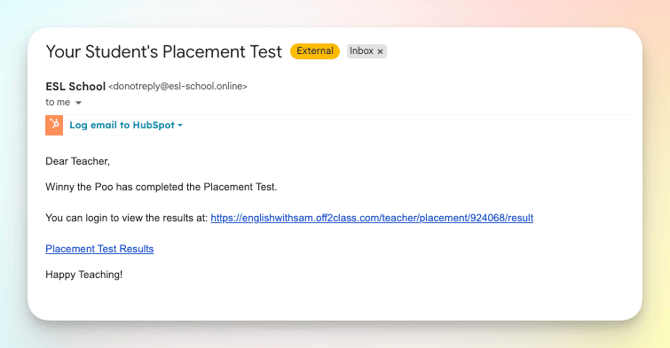
You receive email notifications when your students submit a placement test. Select the link to go straight to the test.
Example of the email you receive:
After reviewing the results, the next step is to choose the right lessons for your student. If you are teaching an individual student or a same-level class, we suggest following the Step-by-Step Curriculum for the student’s level. If you are teaching a mixed-level class, see our article on Teaching Multi-Level Classes for lesson selection guidance or see this detailed guide to choosing lessons for US K-12 students.