
Table of contents:
Overview
The Lesson Library is the heart of Off2Class. It includes over 1,500 teacher-guided lessons for all proficiency levels—covering speaking, listening, reading, and writing.
For a brief video overview of the lesson library, click here.
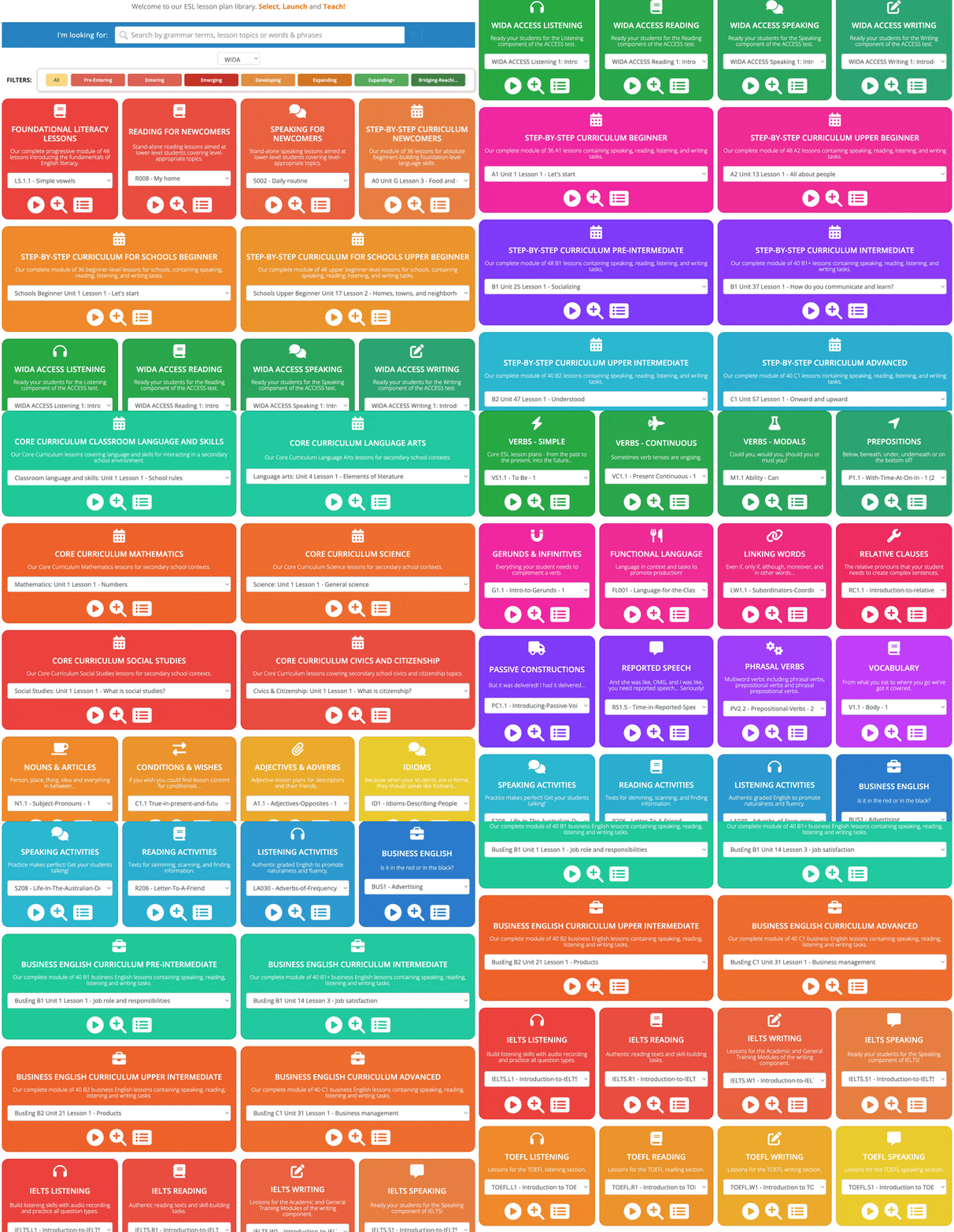
Note that the lesson order in the library changes based on the framework you select!
What lessons should I use?
US K-12
For more complex and detailed recommendations, check out this article.
If you're a US K-12 teacher, you have many places to start in our library. You might begin with Foundational Literacy or Newcomers lessons for students who need the basics, or use our Step-by-Step Curriculum for Schools for a full, structured program. You can also dip into Standalone or Single-Skill lessons to fill specific gaps, and use our WIDA ACCESS prep lessons when it's time for test practice. All of our resources are designed to be mixed and matched based on your students' needs, so create a path that works best for your class.
- Step-by-Step Curriculum for Schools: Follow a structured, level-by-level program to build language skills. (School teachers can use the special Step-by-Step for Schools track tailored to fit classroom schedules.)
- Literacy & Newcomers: Use Foundational Literacy lessons for learners who need basic reading and writing skills, and Newcomers lessons for those just beginning to learn English.
- Core Curriculum: Integrate language learning with academic subjects. These lessons (e.g. Language Arts, Math, Science, Social Studies) help students learn English while engaging with core K-12 content.
- Standalone Lessons: Pick single-topic grammar and vocabulary lessons to target specific language points. These are great for filling in gaps or focusing on a particular skill area your class needs extra help with.
- Single-Skill Lessons: Choose skill-focused lessons (speaking, reading, listening) to give students extra practice in one specific domain of language.
- WIDA ACCESS Prep: Use these test-preparation lessons to get students ready for the WIDA ACCESS English language proficiency exam commonly used in US schools. They help familiarize learners with the test format and question types.
Private ESL (International EFL)
For more complex and detailed recommendations, check out this article.
If you're an international EFL teacher, our library offers flexible resources to fit your teaching setting. Begin with Foundational Literacy or Newcomers lessons for students who are just starting out with English, or follow our Step-by-Step Curriculum to gradually build up their language proficiency. You can supplement your teaching with Standalone or Single-Skill lessons to address particular gaps or focus areas. For exam preparation, we also provide IELTS and TOEFL lessons to help students practice for those international English tests. You can mix and match these materials to suit your students’ goals and backgrounds, creating a customized learning path for them.
- Step-by-Step Curriculum: Use this guided, level-by-level program to steadily improve students’ English. (It provides a clear progression through language levels for a structured learning experience.)
- Literacy & Newcomers: Start with Foundational Literacy lessons for learners who need to develop basic English reading and writing skills, and Newcomers lessons to introduce everyday English to beginners.
- Core Curriculum: Teach English through academic content with lessons covering subjects like Math, Science, and Social Studies. This helps students learn language in context and acquire general knowledge at the same time.
- Standalone Lessons: Select focused grammar or vocabulary lessons to tackle specific language topics. These one-off lessons let you address particular weaknesses or supplement your main curriculum as needed.
- Single-Skill Lessons: Provide extra practice in a specific skill area—be it speaking, listening, or reading—so students can strengthen individual competencies outside of integrated lessons.
- IELTS & TOEFL Prep: Use our exam-focused lessons to prepare students for common international English tests. These lessons familiarize learners with the IELTS and TOEFL formats and help practice the kinds of tasks and skills required for success on those exams.
Lesson Categories
Click on the lesson group name for more information about the lessons. If a lesson group does not have a link, it means we're working on creating an article for it.
Foundational Literacy & Newcomers
- Foundational Literacy: Ideal for all students who need to develop basic literacy skills, including: Newcomers, LTELs and SLIFE (Students with Limited or Interrupted Formal Education) students.
- Reading for Newcomers: For students with a lower proficiency level who need to develop their reading skills.
- Speaking for Newcomers: For students with a lower proficiency level who need to develop their speaking skills.
- Step-by-Step Curriculum Newcomers: For absolute beginners like Newcomers and SLIFE (Students with Limited or Interrupted Formal Education) students.
Step-by-Step Curriculum
- Step-by-Step Curriculum: An all-in-one solution for teaching general English through comprehensive, engaging lessons across all proficiency levels.
- Step-by-Step Curriculum Newcomers: For absolute beginners like Newcomers and SLIFE (Students with Limited or Interrupted Formal Education) students.
- Step-by-Step Curriculum for Schools: For low proficiency secondary school learners in grades 6-12.
Test Preparation
- WIDA ACCESS: Ideal for all students who are preparing to take WIDA ACCESS assessments, including but not limited to: Newcomers, LTELs and SLIFE (Students with Limited or Interrupted Formal Education) students.
- IELTS: Prepares students for IELTS success, covering exam structure, strategies, and targeted practice to build fluency, accuracy, and test confidence across all four sections: Listening, Reading, Speaking, and Writing.
- TOEFL: Builds skills for the TOEFL iBT—Listening, Reading, Speaking, and Writing—through focused exam strategies, scoring criteria, and practice tasks to strengthen comprehension, expression, and academic communication.
Core Curriculum
For students who have already developed basic English proficiency and need support acquiring the language and skills necessary to engage fully with school life, especially LTELs.
- Core Curriculum Classroom Language and Skills
- Core Curriculum Language Arts
- Core Curriculum Mathematics
- Core Curriculum Science
- Core Curriculum Civics & Citizenship
- Core Curriculum Social Studies
Business English Curriculum
- Business English Curriculum: Ideal for all students who need to study English for professional or work-related purposes, including but not limited to: professionals using English at work, jobseekers and high school and university students.
Standalone Language-Focused Lessons
- Nouns & Articles: Covers subject pronouns, articles, and usage of some/any, with structured practice to build accuracy and fluency.
- Conditions & Wishes: Explores first conditional, habitual actions, and expressing hypothetical or emotional states through structured if-clauses.
- Adjectives & Adverbs: Introduces adjectives and adverbs through opposites and comparisons, enhancing descriptive accuracy in speech and writing.
- Idioms: Builds awareness of idioms, their meanings, and connotations, with practice applying them in speaking and writing.
- Verbs - Simple: Focuses on the present simple tense, including verb to be, contractions, negatives, and forming questions.
- Verbs - Continuous: Covers the present continuous tense in positive, negative, and question forms, with focus on real-life use.
- Verbs - Modals: Introduces modal verbs like can/can’t to express ability, possibility, and permission in positive, negative, and question forms.
- Prepositions: Teaches prepositions of time and place (at, on, in) with contextualized practice in daily situations.
- Gerunds & Infinitives: Explores gerunds and infinitives, their forms, uses, and common verb patterns in everyday contexts.
- Travel English: Focused on the practical, real-world English students need when traveling, from planning a trip to navigating airports, hotels, restaurants, and city streets..
- Linking Words: Introduces coordinating and subordinating conjunctions, showing how to connect ideas smoothly in writing and speech.
- Relative Clauses: Covers relative pronouns (who, which, that, whose) to form clear, connected sentences for fluent communication.
- Passive Constructions: Explains active vs. passive voice, when to use each, and how to form passive sentences accurately.
- Reported Speech: Introduces reported speech, including tense shifts and pronoun changes, for accurately retelling statements and questions.
- Phrasal Verbs: Introduces common phrasal verbs with practice in meaning, form, and everyday conversational use.
- Vocabulary: Expands essential vocabulary for specific topics and integrates words into natural, communicative sentences.
Single-Skill Lessons
- Speaking Activities: Encourages the development of spoken fluency and accuracy through practical speaking tasks on relevant topics.
- Reading Activities: Develops reading fluency and comprehension through level-appropriate themed texts with pre-, while and post-reading activities.
- Listening Activities: Builds listening comprehension skills with everyday language in level-appropriate real-life contexts.