
The features mentioned in this article are available to all teachers. Teachers on free subscriptions have access to only a limited number of lessons and cannot enroll multiple students or classes, or use unit checks.
This article is composed of three sections:
Teaching students at one level
After students complete the placement test, use their assigned level to choose a starting point in Off2Class.
- Step-by-Step Curriculum: A comprehensive general English curriculum covering language and skills for students of all proficiency levels.
- Step-by-Step Curriculum for Schools: An adapted version of the existing Step-by-Step Curriculum covering the same language but using themes and content appropriate for students in US secondary schools.
- Step-by-Step Curriculum Newcomers: An absolute beginner-level module of general English lessons to add as a precursor to the existing Step-by-Step Curriculum.
- Foundational Literacy: A Science of Reading-based sequence of lessons teaching basic reading, writing, and literacy aimed at students who lack the literacy skills to access other Off2Class content..
- If you are a US K12 teacher click here.
- If you are an IEFL/Private ESL teacher click here.
Teaching students at mixed levels
- a wide range of proficiency levels
- varied cultural and language backgrounds
- different educational levels (SLIFE, etc)
What resources help me teach mixed-level classes?
1) Step-by-Step Curriculum (level-based)
2) Reading Activities (and reading for Newcomers)
- academic vocabulary
- reading comprehension skills
- engaging, real-world topics
- a variety of level
For lower-level learners, use Reading for Newcomers (stand-alone reading lessons aimed at lower-level students).
3) Speaking Activities (and Speaking for Newcomers)
- a wide variety of topics
- interpersonal communication
- classroom discourse
- options that can be used for independent work
Step 1: Choose the right "anchor" lesson for whole-class instruction
To run a whole-class lesson in a mixed-level group:
-
Select a level closest to the level of your least proficient students.
- Teach the lesson to the whole group, then differentiate the practice so higher-level learners stay challenged.
Pro tip: Use the Teacher Guides (available for Step-by-Step Newcomers, Beginner, Upper Beginner, Speaking for Newcomers, Reading for Newcomers) for ready-to-use differentiation strategies on a slide by slide basis.
Step 2: Differentiate practice without running separate lessons
Strategy A: Tiered questioning
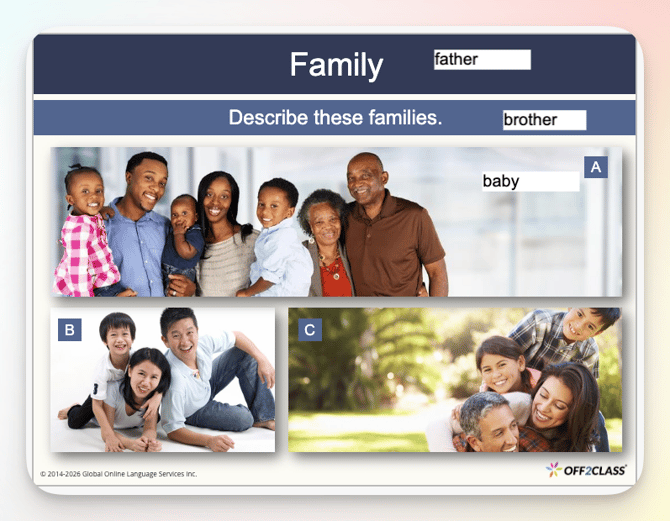
- Beginning+: “How many children are in each picture?” / “Can you name three family members?”
- Intermediate: "How would you describe the relationships________?" / "What similarities and differences do you notice?"
- Advanced: “What assumptions might people make… based only on the photos?”
Strategy B: Scaffold and extend practice
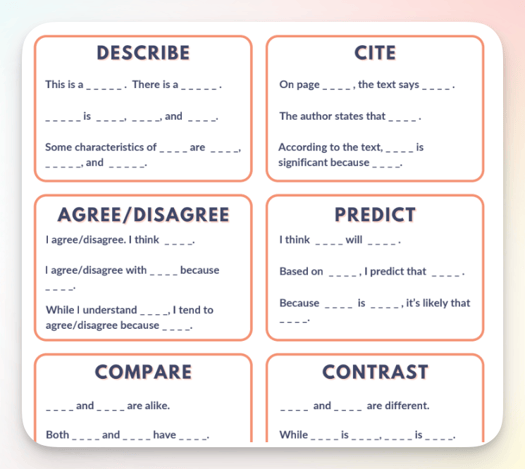
- Provide sentence frames and a word bank (family terms, simple adjectives).
- Offer more complex starters like:
- “In my family, we enjoy ___.”
- “My ____ used to but now ___.”
- Push stronger students with comparative language:
- "Compared to other families, we are________instead of________."
Strategy C: Adjust task complexity
Differentiate by changing what students have to produce:
- adjust the length of the exercise
- add an extra challenge, like using a different tense or structure
- ask students to form questions to quiz their peers, or ask them to teach the content to a partner
Step 3: Use flexible class formats to manage mixed levels
Whole-class instruction
- Engage multiple levels at once
- Use one lesson and differentiate activities
- Pair this approach with the Step-by-Step Curriculum
Paired activities
- Encourage peer learning and support
- Group students by similar or different levels (depending on your goal)
- Use collaborative tasks like Reading or Speaking Activities
Independent work stations
- text-based homework
- speaking homework
- unit checks
Tracking student growth
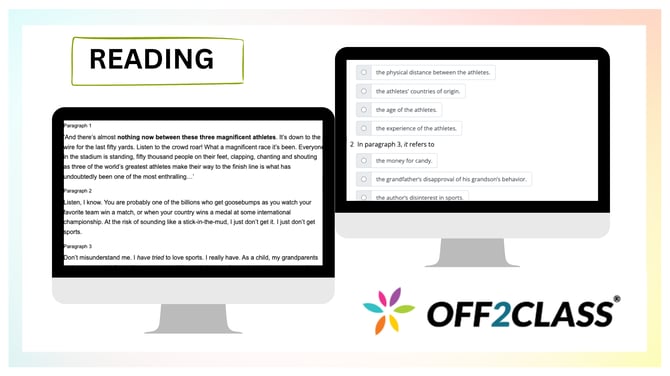
- Reading homework (read a text and answer questions)
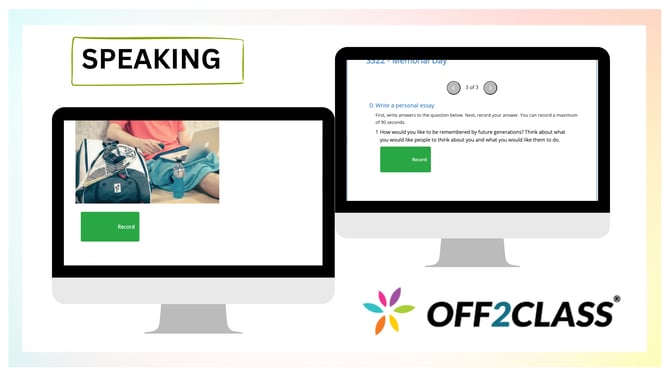
- Speaking homework (students record spoken responses and write free text answers)
Simple routine that works in mixed-level classes:
- Teach one, whole-class lesson (anchored to the least proficient level).
- Differentiate practice (tiered questions, scaffold/extend, and adjust complexity).
- Use stations/paired work to give students the right amount of support or challenge.
- Assign homework and use unit checks at key points to monitor growth.